
The Master Platform Selection Blueprint
How to choose the foundation of your digital empire without living through the agony of platform migration
Choosing an e-commerce platform is the single most consequential decision an online entrepreneur will ever make. It is not like picking an email provider or choosing what color shirt to wear to an interview. Choosing a platform is pouring the concrete foundation of a skyscraper. If you pour that foundation into unstable sand, the building may look gorgeous at two stories high. But the moment your marketing hits, your sales surge, and you attempt to build to the twentieth floor, structural cracks tear through your operation.
Every year, thousands of brilliant, hardworking founders suffer through what we call the Migration Nightmare. They wake up to discover that their store has outgrown its digital walls. Their monthly software fees have ballooned into an extortionate tax, which means paying fees so outrageously high that they eat away your rightful earnings. Their product variations, meaning the different sizes, colors, and models of an item, have overwhelmed the database. Or worse, an automated algorithm, which is a computer recipe making decisions without human empathy, flagged their store and froze their customer payouts overnight. Moving an established e-commerce store with tens of thousands of customer records, years of order history, complex product variations, and fragile search engine rankings is the business equivalent of performing open-heart surgery on a patient while they are running a marathon. It causes weeks of insomnia, tens of thousands of dollars in emergency developer fees, broken links, tanked Google rankings, and lost customer trust.
You sit in the glow of your monitor late at night with twenty open browser tabs. You read promotional blog posts filled with corporate buzzwords, which are fancy, impressive words used by sales companies to make simple ideas sound complicated. You are exhausted by the noise. You are terrified of making a catastrophic mistake before you have even collected your first sale. This master blueprint exists to end that paralysis forever. We will not sell you on empty promises. We will dissect the raw physics, the financial realities, the human skill sets, and the architectural philosophies of the five global commercial engines so you can choose your digital soil with absolute mathematical certainty.
The Lab Glossary: Core Platform Concepts
Extortionate Tax: Excessive recurring software fees and hidden transaction percentages that grow larger as you become more successful.
Variations: The different options available for a single item, such as small, medium, and large, or cotton and wool.
Algorithm: A set of automated digital rules that software uses to make instant decisions without human review.
Buzzwords: Empty corporate slogans that hide technical limitations behind fashionable vocabulary.
01. The Thermodynamics of Digital Trade: Friction and Cognitive Entropy
To evaluate software from first principles, we must understand the fundamental physics of digital commerce. In classical physics, the scientific study of Thermodynamics teaches us that closed systems naturally decay into disorder, a phenomenon known as entropy, unless deliberate energy is continuously applied to keep them organized.
The exact same law governs your online business. Think of a physical lemonade stand on a hot summer afternoon. If your lemonade stand sits directly on the sidewalk, with ice-cold drinks poured instantly and a clear coin box right on the counter, every thirsty passerby buys without hesitation. That is a state of zero friction. Now imagine you put a heavy locked wooden door in front of the stand. You require every customer to fill out a paper questionnaire with five questions before they can order. Then your cash register jams for ten seconds on every transaction. That delay, that confusion, and those barriers represent friction. In e-commerce, friction is any obstacle, hesitation, or delay that stops a customer from completing their purchase.
Research confirms that a mere one-second delay in latency, which is the annoying pause between a user clicking a button and the website responding, cuts your conversion rate by up to twenty percent. Your conversion rate is simply the percentage of visitors who actually pull out their credit card and buy. If your store has high friction, customers do not wait patiently. They close the browser tab, open an app, and buy from your competitor.
Equally critical is your own Cognitive Bandwidth. Human beings possess a finite, meaning strictly limited, amount of mental clarity, creativity, and willpower each day. When your mental tank runs dry, you suffer from decision fatigue. Every hour you spend troubleshooting, which is the exhausting process of tracking down software bugs through painful trial and error, is an hour stolen from your business. If you spend your morning fixing broken database tables and debugging server caching errors, you have zero cognitive bandwidth left to craft persuasive marketing campaigns, negotiate better pricing with manufacturers, or build personal relationships with your best buyers.
The Lab Glossary: Scientific Commerce Terms
Thermodynamics: The branch of science explaining how energy moves and why systems naturally fall into clutter and confusion without continuous maintenance.
Friction: Any technical delay, confusing layout, or extra checkout step that slows a customer down.
Latency: The split-second lag time between clicking a link and the screen actually loading.
Conversion Rate: The percentage of web visitors who complete a transaction.
Cognitive Bandwidth: The daily reservoir of focused mental energy a founder possesses before becoming overwhelmed.
Finite: Having an absolute limit, like a fuel tank that empties with every mile driven.
Troubleshooting: The methodical process of diagnosing and resolving technical malfunctions.
02. The Five Foundational Archetypes Under the Lens
Across the global landscape of digital commerce, five foundational archetypes, which are master blueprints representing different operating models, have risen to dominate the market. Each represents a distinct compromise between ease of use, data sovereignty, and technical responsibility.
The Lab Glossary: Operational and Design Architecture
Archetype: A universal model or master blueprint that serves as the baseline for a specific category.
Merchant: A business operator who sells real goods for profit, requiring predictable operational systems.
Autonomy: The freedom to operate your business and manage your customer records without asking permission from an external corporate board.
Open-Source: Software whose underlying code is publicly available for anyone to use, modify, and host on their own terms.
Arbitrary Penalties: Extra percentage fees imposed on transactions simply because a platform controls the checkout gate.
Multi-Channel: The ability to sell across multiple distinct marketplaces, social stores, and web properties from a single inventory hub.
Aesthetics: The visual harmony, color balance, and emotional elegance of your store presentation.
Typography: The deliberate styling and arrangement of written fonts to ensure effortless readability.
Configurations: The internal dials, toggles, and parameter settings that control how a software program behaves.

Archetype 01: Shopify (The Hosted Sovereign Monolith)
Shopify represents the pinnacle of hosted Software as a Service. You never interact with raw code or worry about server crashes during a massive marketing campaign. Shopify manages the entire industrial machinery in exchange for a predictable monthly subscription and a transaction percentage. It provides unmatched speed to market, elite checkout speed, and global scaling. However, you operate as a tenant within a closed digital garden. You must adhere to their ecosystem rules, and using external payment processors triggers extra transaction fees.
Day-One Workforce Requirements: Zero technical staff. A solo founder with basic computer skills can launch and operate a full store without writing a single line of code or hiring an engineer.
The Founder Journey: How Gymshark Scaled from a Garage to a Global Empire
In 2012, a nineteen-year-old college student named Ben Francis started Gymshark in his parents' garage in the United Kingdom. He hand-sewed athletic apparel, screen-printed vests, and fulfilled orders manually. As his social media presence grew, his store experienced immense spikes in traffic. Gymshark initially launched on a self-hosted platform, but on Black Friday in 2015, the massive surge of traffic overwhelmed their custom servers. The website crashed completely for eight hours, resulting in an estimated loss of over one hundred thousand dollars in sales and acute brand embarrassment.
Realizing that his core mission was designing apparel and inspiring fitness communities, not managing server infrastructure, Ben made the strategic decision to migrate the entire company to Shopify Plus. The hosted cloud infrastructure absorbed global flash sales with zero downtime, allowing the team to focus entirely on athlete marketing and supply chains. Today, Gymshark is valued at over one billion dollars, processing thousands of orders per minute across multiple continents from a unified cloud engine.

Archetype 02: WooCommerce (The Open-Source Sovereign Workshop)
WooCommerce is the champion of merchant autonomy, meaning the absolute freedom to direct your business without third-party permission. Running directly inside your self-hosted WordPress installation, it guarantees complete ownership over your customer records, order histories, and transaction rules. There are zero platform taxes and zero arbitrary penalties for connecting your own preferred payment processor. The trade-off is complete operational responsibility: you must manage your own hosting soil, perform updates, and ensure plugin harmony.
Day-One Workforce Requirements: Moderate technical comfort. The founder must understand WordPress basics, or budget for an on-call freelance WordPress developer to handle server configurations, plugin updates, and backup restorations.
The Founder Journey: How Root Science Built a Clean Skincare Authority on Open Soil
Root Science was founded by Anina Malherbe-Begun, who set out to create pure, organic topical formulas for sensitive skin. Her business model did not rely on noisy viral social media ads. It relied on scientific authority, exhaustive ingredient education, and deep customer trust. Her digital store required an editorial publishing experience where comprehensive ingredient research, dermal health articles, and high-tier botanical formulations lived side-by-side on the exact same domain without jarring transitions.
Closed hosted platforms felt restrictive to her brand vision. They imposed rigid page layouts and charged extra fees for the custom product tables and educational modules she required. Anina chose WooCommerce running on WordPress. This decision allowed Root Science to maintain complete ownership of their content universe, customize their ingredient displays, and integrate their product catalog seamlessly into an organic educational blog. By retaining full sovereignty over their customer data and avoiding platform rental fees, Root Science scaled into a globally recognized luxury skincare brand featured in premier publications worldwide.

Archetype 03: BigCommerce (The Open SaaS Heavyweight)
BigCommerce delivers enterprise-grade retail muscle directly out of the box. While other hosted platforms require you to install dozens of expensive third-party apps for wholesale business-to-business pricing, multi-channel selling, and advanced product options, BigCommerce bakes these capabilities straight into its core engine. Most importantly, it charges zero arbitrary transaction penalty fees regardless of which payment processor you connect.
Day-One Workforce Requirements: Low to moderate technical skills. Built-in enterprise controls reduce the need for custom coding, though setting up complex multi-channel feeds benefits from an experienced e-commerce operations manager.
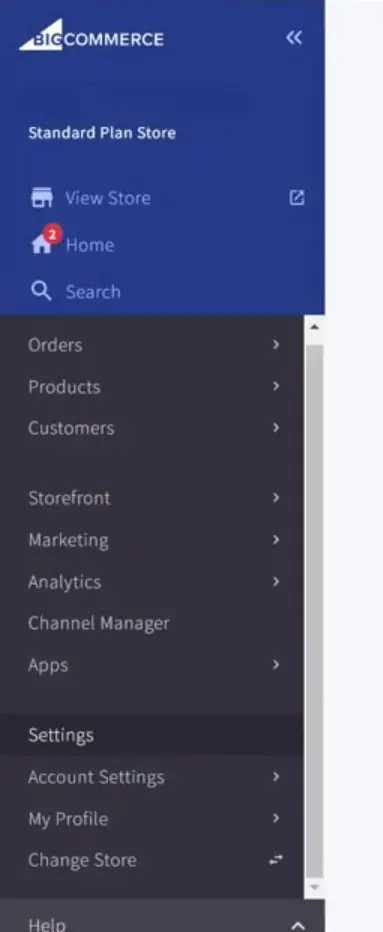
The Built-In Omnichannel Command
Observe the BigCommerce command sidebar. Notice how Channel Manager sits right alongside native Marketing and Storefront controls.
This is physical proof of the platform's architectural focus. It allows high-volume merchants to sell on Amazon, eBay, social storefronts, and multiple regional websites from a single synchronized database without relying on fragile third-party sync apps that break during holiday inventory spikes.
The Founder Journey: How Mountain Crest Gardens Conquered Complex Botanical Logistics
Mountain Crest Gardens is a family-owned nursery in Northern California specializing in rare succulents. Their business model involves exceptional inventory complexity. They manage hundreds of living plant varieties, each with distinct seasonal weather shipping requirements, bulk wholesale pricing tiers for landscapers, and retail options for casual home gardeners.
On basic hosted platforms, the team hit a wall. Managing custom wholesale pricing and variant rules required stacking dozens of expensive apps on top of each other. These apps conflicted with each other, slowed page speeds, and drove monthly software expenses through the roof. The nursery migrated to BigCommerce to take advantage of its native multi-tier pricing, built-in custom fields, and robust inventory handling. By eliminating app bloat and utilizing the native Channel Manager, Mountain Crest Gardens scaled to become the largest online succulent marketplace in the United States without technical interruptions.

Archetype 04: Squarespace (The Curated Boutique Gallery)
Squarespace approaches commerce from an editorial design perspective. It was created for founders whose commercial success relies heavily on visual aesthetics, typography, visual portfolios, and storytelling. It eliminates technical software overhead, providing an intuitive canvas where visual brand identity, appointment booking, digital courses, and boutique merchandise operate in complete visual harmony.
Day-One Workforce Requirements: Completely self-sufficient. Designed specifically for non-technical creators, artists, and boutique service providers. No coding knowledge or webmaster support is required.

The Content and Commerce Harmony
Examine how the Squarespace sidebar organizes its universe. It places Products and Services directly above Content and Memberships, featuring native tools for Scheduling, Donations, and Invoicing.
This is visual proof that Squarespace is built for the Modern Creator. It avoids warehouse logistics complexity and gives authors, consultants, coaches, and luxury boutique makers a unified dashboard where content feeds and commerce operate in seamless visual balance.
The Founder Journey: How Arch Motorcycle Built an Exclusive Luxury Experience
Arch Motorcycle was co-founded by Keanu Reeves and Gard Hollinger to build bespoke, American-made performance luxury motorcycles. Their business model is not about high-volume mass production. Each motorcycle is a bespoke, hand-crafted work of mechanical art costing near one hundred thousand dollars. Every customer interaction is an exclusive, high-touch consultation.
They did not need an industrial e-commerce warehouse cart with twenty discount popups and complex coupon logic. They needed a digital presence that matched the sculptural elegance, clean lines, and visceral beauty of their machines. Arch Motorcycle selected Squarespace because its typography, fluid layouts, and full-bleed visual galleries allowed them to present their bespoke builds like an art exhibition. The platform gave them the exact tools needed to tell their engineering story and manage private customer inquiries with zero software complexity.

Archetype 05: Adobe Commerce and Magento (The Industrial Railway)
Adobe Commerce, powered by the open-source Magento core, is the heavy freight train of the global digital economy. It was engineered for complex corporate enterprises managing millions of dollars in inventory, multiple corporate subsidiaries, complex wholesale business structures, and international multi-warehouse logistics across dozens of languages and currencies. It offers unmatched computational power, but demands dedicated engineering teams and substantial financial capital.
Day-One Workforce Requirements: Heavy technical payroll. Requires a dedicated Senior Full-Stack PHP Developer, a certified Magento Architect, and a DevOps Server Administrator to manage security configurations, caching, and code deployments.
The Founder Journey: How Helly Hansen Mastered 140 Years of Global Heritage
Founded in Norway in 1877, Helly Hansen has spent over a century producing professional-grade technical gear for sailors, skiers, and mountain rescue teams. Their operational scale is immense. They operate dozens of localized digital storefronts across North America and Europe, managing multiple regional languages, diverse tax structures, localized payment methods, and physical distribution warehouses located in different legal territories.
A standard retail shopping cart would crumble under this degree of regional complexity. Helly Hansen runs on Adobe Commerce and Magento. This architecture enables a single corporate engineering team to control a unified master database while serving distinct, localized storefronts tailored to individual currencies and languages. By connecting their enterprise resource planning systems and warehouse logistics directly to Magento, Helly Hansen processes millions of transactions while maintaining zero friction for customers scaling mountains across the world.
03. The Workforce and Technical Skill Audit: Who Actually Does the Work?
A fatal mistake in e-commerce strategy is failing to match your software choice to your human payroll reality. When people casually speak of touching code, managing PHP versions, and troubleshooting server caching, they are not describing casual everyday computer tasks. They are describing three specific technical professions.
1. Touching Code: This refers to writing and editing programming languages like HTML, CSS, JavaScript, and PHP. This is the work of a Full-Stack Web Developer. If you cannot read code, attempting to fix a syntax error in your checkout script will take down your entire store, leaving you staring in panic at a blank white screen.
2. Managing PHP Versions: WordPress and WooCommerce run on a server programming language called PHP. Web hosting servers regularly update their PHP versions for security. When your host updates to a newer version, older plugins can become instantly incompatible, breaking critical website features. Managing this process requires a Webmaster or Technical Administrator who knows how to test updates on a staging server before pushing them live.
3. Troubleshooting Server Caching: Caching stores static snapshots of your website pages so they load at high speed. However, in an active store, caching must be configured so that customer shopping carts and live inventory counts never get cached. If caching fails, one customer might see another customer's personal shipping address, or an item will show as in stock when it is already sold out. Fixing these conflicts is the job of a DevOps or Server Systems Engineer.
04. The Three-Year Total Cost of Ownership Audit
A common error made by new founders is looking solely at the advertised monthly sticker price on a software pricing page. As Lead Researchers, we audited the true three-year capital expenditures across all five platforms, factoring in base subscriptions, transaction penalty fees, hosting infrastructure, and mandatory application ecosystems.
The 2026 Financial Cost Landscape
- Shopify Architecture Costs: Entry plans start at $39 per month ($468 per year). However, scaling past basic operations requires paid monthly apps for reviews, upsells, and subscriptions, pushing real operational software costs to $150 to $300 per month. Over three years, software costs range from $5,000 to $12,000. Additionally, using third-party payment gateways triggers a 0.5% to 2% transaction fee penalty unless you use Shopify Payments.
- WooCommerce Architecture Costs: Core software is $0. High-performance managed hosting costs $10 to $35 per month ($120 to $420 per year). Domain registration is $15 per year. Premium extensions for subscriptions or advanced wholesale pricing average $100 to $300 annually. Total three-year capital investment ranges from $600 to $2,500. Zero arbitrary transaction fee penalties exist.
- BigCommerce Architecture Costs: Plans start at roughly $39 per month, scaling to $105 and $399 as sales volume expands. Crucially, BigCommerce charges 0% transaction penalty fees regardless of which payment processor you connect. Because advanced B2B features, product options, and multi-currency tools are native, app subscription bloat is drastically reduced. Three-year costs average $2,500 to $7,000.
- Squarespace Architecture Costs: Business plans range from $23 to $65 per month billed annually ($276 to $780 per year). On lower tiers, a 3% transaction fee applies, making the dedicated Commerce plan the mandatory choice for serious trade. Total three-year expenditure stays exceptionally predictable at $800 to $2,300 with almost zero additional app costs.
- Adobe Commerce and Magento Costs: While the open-source community edition is free to download, hosting and maintaining an enterprise Magento database demands dedicated cloud infrastructure costing $300 to $2,000 per month. Custom development, enterprise security patches, and agency retainers push real annual operational expenditures from $25,000 to over $100,000.
05. The Laboratory Compass: The Six-Lens Diagnostic Formula
To eliminate decision fatigue, run your business through our scientific six-lens diagnostic framework. Answer these six operational questions to identify your ideal commercial home with mathematical clarity.
Lens 1: What is your technical tolerance? If touching code, managing PHP versions, and troubleshooting server caching causes you acute anxiety, eliminate WooCommerce and Magento immediately. Choose Shopify for pure retail speed, or Squarespace for visual design simplicity.
Lens 2: What is your product complexity? If you sell twenty boutique items, digital downloads, or creative consulting services, Squarespace is your natural home. If you sell five hundred physical consumer products, Shopify excels. If you sell complex machinery with thousands of configurable variations, custom pricing tiers, and wholesale buyer portals, BigCommerce or Magento are mandatory.
Lens 3: What is your content architecture? If your business model is seventy percent high-authority editorial content, organic publishing, investigative reviews, podcasts, and thirty percent digital merchandise, WooCommerce running on WordPress is unbeatable. No other platform matches the organic publishing power of the WordPress core.
Lens 4: What is your multi-channel strategy? If your business requires selling simultaneously across physical points of sale, Amazon, eBay, Google Shopping, TikTok Shop, and regional sub-brands from day one without installing seven third-party sync apps, BigCommerce provides the most robust native multi-channel engine.
Lens 5: Who owns the underlying soil? If you operate in an industry subject to sudden corporate terms of service revisions, merchant account freezes, or regional digital restrictions, you cannot risk building on closed SaaS platforms. You require the digital sovereignty of a self-hosted WooCommerce engine where your database cannot be turned off by an executive board.
Lens 6: What is your true capital runway? If you have limited capital today but substantial time to learn your machine, WooCommerce delivers the lowest barrier to entry. If you have solid cash flow and prioritize buying back your time so you can focus exclusively on marketing, Shopify or BigCommerce represent superior capital leverage.
There is no single best e-commerce platform in absolute terms. There is only the exact platform that matches your cognitive capacity, your business model, and your financial runway. If speed, conversion, and zero server maintenance are your priorities, choose Shopify. If total data ownership, editorial content harmony, and long-term cost minimization are paramount, choose WooCommerce. If native wholesale depth and multi-channel trade without gateway penalties are essential, choose BigCommerce. Match the engine to your mission, build your foundation on solid soil, and refuse to become a victim of the migration trap.
Lab Rating: 10/10, Universal Decision Blueprint
Primary Recommendation: Never pick a platform to satisfy where your business sits today. Pick the platform that can hold the weight of where your business will stand three years from now. Pour your foundation once, pour it deep, and build your cathedral with pride.