
Shopify: The Engine of Modern Trade

Is Shopify the end of your box-taping purgatory?
You have a gift. You have created something beautiful, or you have sourced a product that you know can change lives. You have felt that rush of adrenaline when the first notification pings on your phone. But lately, that sound does not bring joy. It brings a tightening in your chest. You are currently living in what we call the Manual Middle.
It is 11:00 PM. You are surrounded by half-taped cardboard boxes, messy spreadsheets, and a pile of handwritten shipping labels that look like they were written by a person in a storm. You are manually checking your bank app to see if a customer from Instagram actually sent the payment before you ship their order. You are terrified that you will oversell your stock and have to send that soul-crushing apology email to a paying customer. You feel like a warehouse clerk who accidentally started a business. You have reached a block. You are overworked, overwhelmed, and you are starting to wonder if going big is even worth the exhaustion. Deep down, you know you do not have a business yet. You have a very loud, very demanding job. This is the exact moment where an engine like Shopify was designed to step in.
01. Identity & Origin: The Snowdevil First Principle
To understand Shopify, we must look at a frustrated programmer in Canada named Tobias Lütke in 2004. He did not set out to build a billion-dollar tech giant. He just wanted to sell snowboards online. His shop was called Snowdevil. At the time, the existing software was hell. It was clunky, it was ugly, and it made selling feel like a chore. Tobias realized a First Principle of Business. The person with the best product should not have to be a computer scientist to sell it.
He built his own tool to solve his own burnout. He realized that the old-school way of doing business involved renting a physical shop, buying a cash register, and hiring a bookkeeper to watch the inventory. Shopify was created to replace that entire physical stack with a single digital login. It was built for the Frustrated Founder, the person who wants to focus on the product while the machine handles the trade.
02. Who is it For? The Lab Personas
Our research shows that Shopify is not a one-size-fits-all tool. It was engineered for three specific types of entrepreneurs.
The Maker: The artist or craftsman who creates their own goods. Shopify gives them a professional storefront that makes their garage-built brand look like a global entity.
The Retailer: The physical shop owner who is tired of being limited by the people walking past their window. Shopify allows them to move their physical inventory onto a digital shelf that is visible to the entire world.
The Dropshipper: This is the model that has changed the life of the aspiring entrepreneur. Dropshipping is a way to sell products without ever touching the inventory. Think of it like this. You show a picture of a product in your shop. A customer buys it from you. You then use a portion of that money to buy the item from a supplier who ships it directly to the customer. You are the digital middle-man who keeps the profit in the middle. Shopify is the gold standard for this because it has dedicated apps that connect your store directly to global warehouses, making the entire process click-and-point.
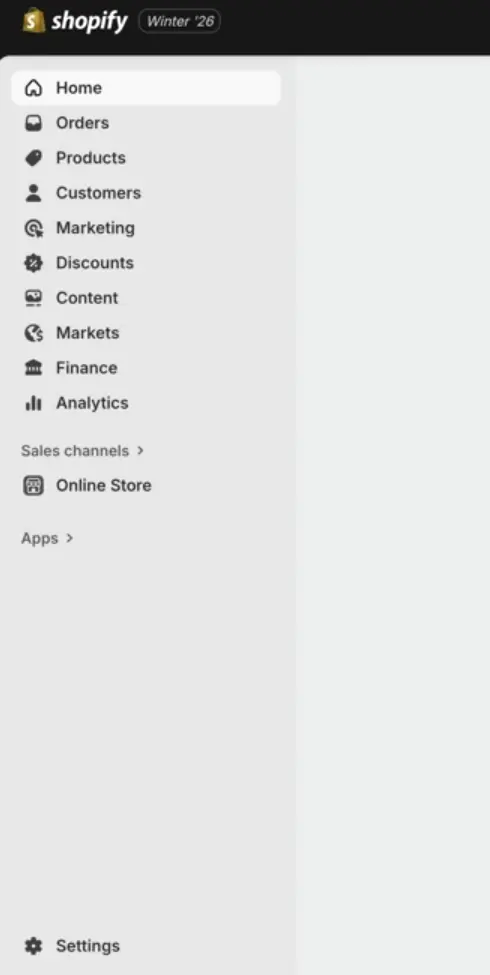
The Command Center Analysis
Our lead researchers have audited the Winter '26 Edition of the Shopify engine. This sidebar is the nervous system of the business. Notice how Analytics, Finance, and Marketing are all accessible within one click. This replaces the old-school need for three different pieces of software and a physical bookkeeper. Everything we discussed in the Manual Middle is solved right here.
03. The Mechanics: How Does Shopify Actually Work?
To truly understand the engine, we must divide it into two parts. Think of a theater. There is the stage where the actors perform, and there is the backstage where the lights and props are managed. Shopify handles both simultaneously.
The Stage (Front-end): This is what your customer sees. It is your theme, your high-quality images, and your buy buttons. Shopify provides the templates so you do not have to write a single line of code to look professional. It is responsive, meaning it looks just as beautiful on a mobile phone as it does on a desktop computer.
The Backstage (Back-end): This is your Shopify Admin. This is where you set your rules. When a customer enters their credit card on the stage, the backstage springs into action. It calculates the tax based on the customer's location, it verifies the payment with the bank, and it sends the order to your shipping department. It even manages the Inventory Logic. If you only have one item left, the machine will hide the buy button the second that item is sold so you never have to deal with an overselling nightmare.
The Ecosystem (Apps): Imagine your Shopify store is a smartphone. The basic phone can make calls and send texts. But if you want to edit professional photos or order a taxi, you download an app. Shopify has an App Store with thousands of tools. If you want to add a product review section or a live chat button, you simply click install and the machine integrates it for you.
04. The Tycoon Stories: From Zero to Empire
Shopify is not just theory. It is the soil where empires grow. Take Gymshark for example. It started with a teenager in a garage screen-printing t-shirts. Because Shopify allowed him to handle 10,000 orders as easily as 10, his brand grew into a billion-dollar household name. Or consider Jimmy Lion, a brand that started with a simple idea for colorful socks and used Shopify's automated trade engine to reach feet in over 50 countries. These are people who moved past the Manual Middle by trusting a system.
05. The Business Logic: Tiers, Costs, and Transaction Fees
As Lead Researchers, we must look at the hard numbers. Shopify is a SaaS business, which means you are renting the engine rather than building it yourself. To make the best decision for your lab, you must understand the two types of costs: the Subscription Fee and the Transaction Fee.
The 2026 Price Stack (Lead Researcher Audit)
- Basic ($39 per month): Best for starters and dropshippers. Online credit card rates are roughly 2.9% plus 30 cents per transaction.
- Shopify ($105 per month): Best for growing teams. Credit card rates drop to 2.6% plus 30 cents. You get professional reports.
- Advanced ($399 per month): For the Tycoons. Credit card rates drop to 2.4% plus 30 cents. You get custom report builders.
Tycoon Tip: If you pay for the year upfront, you save 25% on these prices. This is how successful founders keep more profit in their own pockets.
Researcher's Tip: Shopify frequently runs a 1 month for $1 promotion for new labs. This is the perfect window to set up your rules and import your products with almost zero financial risk.
The Shopify Payments Advantage: If you use Shopify Payments as your gateway, Shopify waives the extra third-party transaction fees. This makes the platform significantly cheaper than its competitors.
Is it expensive? Only if you value your time at zero dollars. If Shopify saves you 10 hours of manual data entry a month, the Basic plan is costing you less than four dollars per hour for an elite employee who never sleeps. That is the definition of Strategic Leverage.
Shopify is the gold standard for a reason. It is the only platform that has successfully balanced sophisticated power with simple logic. It replaces the Manual Middle with an automated engine of growth. Whether you are a maker or an aspiring dropshipper, if you are serious about moving from a hobbyist to an entity, this is your foundation.
Lab Rating: 10/10, The Mandatory Commerce Engine
Primary Recommendation: Do not get stuck in design paralysis. Start on the Basic plan with the $1 promotion, pick a clean theme, and get your products live. Let the machine start doing the handshakes so you can get your sleep back.