
WooCommerce: The Sovereign Engine of Open Trade

Is WooCommerce the cure for your platform rental anxiety?
There is a quiet anxiety that lives in the chest of every modern online seller. You build your business inside a clean subscription software platform. You pay your monthly fee on time. You celebrate when your sales numbers climb. But late at night, when the screen goes dark, a specific realization creeps in. You do not actually own the soil on which your business stands. You are a tenant in a digital shopping mall.
You worry about waking up to an email stating that your account has been flagged by an automated algorithm. You watch your monthly software bills increase as your revenue grows, with fees layered on top of fees simply because you chose a payment provider the platform dislikes. You want to customize a checkout step or offer a unique product package, but you hit a concrete wall because the platform forbids you from modifying the core code. You feel cornered between two extremes. On one side is the easy subscription platform that charges you rent forever and treats you like a tenant. On the other side is the terrifying open web with databases, web servers, and technical jargon that makes you feel like an imposter. This is the moment where an engine like WooCommerce demands your attention.
01. Identity & Origin: The WooThemes Rebellion
To understand why WooCommerce exists, we must travel back to 2011. Two entrepreneurs named Adii Pienaar and Magnus Jepson, alongside Mark Forrester, ran a company called WooThemes. They built visual designs for WordPress websites. Their customers kept asking one persistent question. How do we sell products directly from our WordPress websites without handing our business over to closed proprietary platforms?
Two talented developers named Mike Jolley and James Koster set to work. They took an existing commerce project called Jigoshop and rebuilt it from first principles. In September 2011, WooCommerce was born. It was released under the General Public License (GPL), which is the digital equivalent of a public constitution. It stated that the code belonged to humanity. Anyone could download it, inspect it, modify it, and run it on their own web server without paying a single dollar in license fees.
By 2015, the platform had become so widely used across the globe that Automattic, the parent company of WordPress founded by Matt Mullenweg, acquired it. Today, WooCommerce powers nearly thirty percent of all online stores across the entire internet. It was built for the Sovereign Merchant, the founder who insists on owning their own customer list, their own database, and their own digital destiny.
02. The Command Center Analysis
Because WooCommerce is not a standalone platform, its control room lives directly inside your WordPress administration dashboard. Our lead researchers have captured the product machinery in action below.
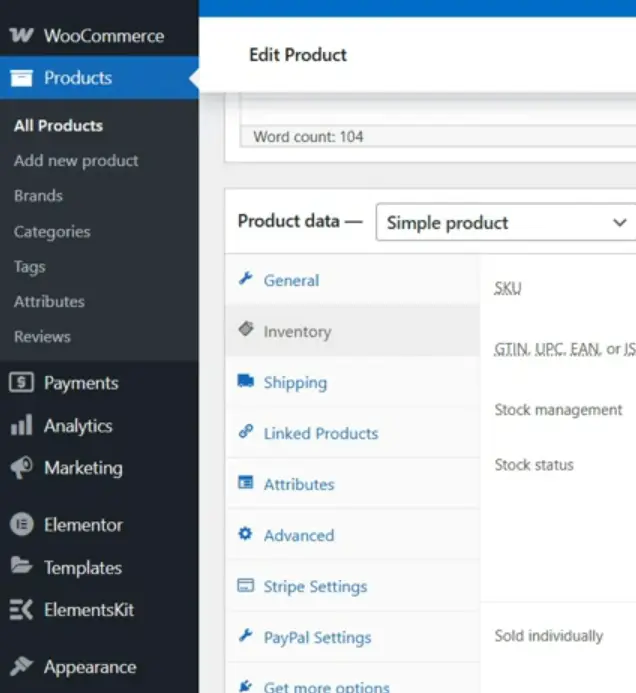
The Engine Inside the Chassis
Observe the dark sidebar on the left. You see standard WordPress controls alongside visual page builders like Elementor, sitting right next to WooCommerce and Products.
This is visual proof of our core thesis. WooCommerce is not a separate application. It turns the entire WordPress publishing engine into a transactional warehouse where you control the inventory, the shipping rules, and the payment gateway directly from your own server.
03. The Mechanics: How Does WooCommerce Actually Work?
To grasp the engineering of WooCommerce, we must dismantle it into four distinct layers. If Shopify is a turnkey luxury apartment in a high-rise building, WooCommerce is a custom house built on your own private plot of land.
Layer 1: The Land (Web Hosting): You buy a plot of ground on a server from a hosting provider like SiteGround, Hostinger, or a dedicated cloud host. This server stores your files and your database. No corporate board can evict you from this land as long as your hosting bill is paid.
Layer 2: The House Frame (WordPress): You install WordPress onto that hosting. WordPress provides the foundation, the room layout, the security doors, and the publishing system for your articles and pages.
Layer 3: The Retail Shelves (WooCommerce): You activate the free WooCommerce plugin. Instantly, your WordPress frame gains a shopping cart, a customer account area, an inventory database, tax calculation tables, and checkout gateways like Stripe and PayPal.
Layer 4: The Custom Additions (Plugins and Extensions): Because the core code is completely open, you can add any specialty room you desire. Need recurring subscriptions? Install an extension. Need custom delivery date pickers for a bakery? Install a plugin. You never have to ask permission from a platform company to change how your store behaves.
04. The Business Logic: The Myth of "Free" and the 2026 Price Stack
We must speak with absolute financial honesty as Lead Researchers. You will often hear people say that WooCommerce is free. That statement is technically true, but practically misleading. The software code is zero dollars, but the infrastructure required to run that code professionally costs money.
The 2026 True Cost of Ownership Audit
- WooCommerce Core Engine: $0 forever. Downloadable, auditable, and unblockable open-source code.
- Web Hosting: $4 to $25 per month for starter stores. As you grow to hundreds of thousands of visitors, high-performance managed hosting costs $35 to $100 per month.
- Domain Name: Roughly $12 to $15 per year for your custom web address.
- Security Certificate (SSL): $0. Almost all quality web hosts provide free Let's Encrypt certificates.
- Theme (The Visual Skin): $0 for the official Storefront theme, or a one-time fee of $49 to $79 for a high-tier commercial design.
- Premium Extensions: $0 to $199 per year. Basic stores need zero paid extensions. Specialized businesses requiring recurring memberships or complex bookings pay an annual fee per tool.
The Sovereign Dividend: WooCommerce never charges you arbitrary extra penalty fees for using your own preferred payment processor. You only pay standard interchange rates to Stripe or PayPal (roughly 2.9% plus 30 cents).
Let us look at the three-year math from a Tycoon perspective. A starter Shopify store costs you $39 per month, which equals $468 per year, or $1,404 over three years before you buy a single custom app. A self-hosted WooCommerce store running on solid hosting can cost as little as $80 to $150 per year, totaling under $450 over that same three-year period. You save approximately one thousand dollars while retaining full ownership of your data.
05. Who is WooCommerce Engineered For?
Our lab investigations confirm that WooCommerce is the superior choice for specific business profiles.
The Content and Commerce Entity: Businesses that combine high-value education, active blogs, podcast feeds, or digital publications with a product store. Because WordPress is the world's most powerful content management system, your articles and your products live under the exact same roof without messy subdomains.
The High-Volume Merchant: As a store scales to millions in revenue, paying platform transaction cuts and expensive enterprise software tiers becomes a severe drain on margins. Large merchants choose WooCommerce because they can scale their own servers without paying a percentage of their gross sales to a software company.
The Bespoke Operator: Companies selling custom configured products, wholesale business-to-business packages, specialized bookings, or items that face sudden policy changes on corporate SaaS platforms. With WooCommerce, you write your own rules.
WooCommerce is the champion of digital self-determination. It trades the hand-held simplicity of closed platforms for total operational freedom, lower long-term overhead, and true ownership of your business assets. If you are willing to learn the basics of your own engine, WooCommerce will reward you with an enterprise that no corporate landlord can ever shut down.
Lab Rating: 9.7/10, The Sovereign Standard
Primary Recommendation: Do not choose cheap, unreliable shared hosting. Invest in a quality host that provides one-click WordPress and WooCommerce installation with automated daily backups. You are the mechanic of your own vehicle, so build your workshop on solid ground.