
Hostinger: The Cloud Foundation for Sovereign WooCommerce

How to deploy an enterprise-grade WooCommerce store on managed cloud infrastructure without paying agency server fees
There is a specific, suffocating terror that strikes new business owners the first time they attempt to set up web hosting. You decided to build your store on WooCommerce because you value sovereignty. You want to own your customer list, avoid platform taxes, and hold the deed to your own digital soil. But the moment you search for hosting, you are pushed into a technological house of horrors.
For more than two decades, legacy web hosting companies treated human beings like corporate network engineers. They forced you into ancient server portals called cPanel, designed in the late 1990s. You were suddenly confronted with hundreds of tiny, terrifying icons labeled phpMyAdmin, Apache Handlers, Cron Jobs, SSH Keys, and MX Records. One wrong click felt like detonating your entire store. You wondered why on earth selling a physical t-shirt, a handcrafted leather wallet, or a bag of organic coffee required an advanced degree in computer science. Even worse was the betrayal of cheap shared hosting. You signed up for an advertised promotional rate of two dollars a month, only to discover that your store was shoved onto an overloaded computer with five thousand other websites. The moment twenty customers arrived at your store at the same time, your checkout ground to a halt, your database timed out, and your sales vanished.
This technical intimidation is the primary reason millions of entrepreneurs surrender their sovereignty and retreat into expensive closed platforms that charge them rent forever. Hostinger was built to break that trap. They asked a fundamental first-principles question: Why cannot enterprise-grade cloud server hosting look as clean, friendly, and visual as a modern smartphone app? This investigation audits how Hostinger engineered their custom hPanel and LiteSpeed server architecture to make sovereign e-commerce accessible to everyday merchants without hiring an IT department.
The Lab Glossary: Web Hosting Mechanics
Web Hosting: The physical computer server connected to high-speed internet that stores your website files, databases, and product media.
cPanel: An old-fashioned, cluttered software control panel created in 1996 that most legacy hosting companies still force beginners to use.
hPanel: Hostinger's custom-built, modern administrative dashboard engineered to make server management simple, visual, and non-technical.
Shared Hosting: An entry-level hosting model where hundreds of websites share the exact same computer processor and memory, causing severe slowdowns if one site gets busy.
Cloud Hosting: A modern infrastructure model where your store runs on dedicated virtual server resources that never slow down when neighboring websites spike in traffic.
01. Identity & Origin: The Democratization of Server Power
Hostinger began its journey in Lithuania in 2004 under a simple founding philosophy: giving anyone on earth the ability to launch a digital presence for free. As the open web expanded, the company recognized that legacy web hosting providers were growing stagnant, lazy, and predatory. They lured first-time founders with cheap introductory prices, locked them into outdated server technology, and charged exorbitant renewal fees while providing cryptic, unhelpful customer support.
In 2019, Hostinger made an aggressive architectural pivot. They walked away from licensing legacy third-party server control panels and invested millions of dollars into engineering their own proprietary system, hPanel. Rather than forcing merchants to decipher raw technical codes, hPanel reduced server administration to clean toggles, intuitive visual checklists, and automated maintenance workflows. They coupled this modern interface with high-performance LiteSpeed Web Server technology, replacing sluggish legacy Apache servers with event-driven architecture capable of processing thousands of database requests per second.
Today, Hostinger serves over three million website creators across more than one hundred and fifty countries. They are not built for Fortune 500 corporate IT departments. They were engineered specifically for the Resource-Constrained Founder: the solopreneur, the boutique maker, and the growing e-commerce merchant who demands rapid server speed and complete data sovereignty without burning their startup budget on developer retainers.
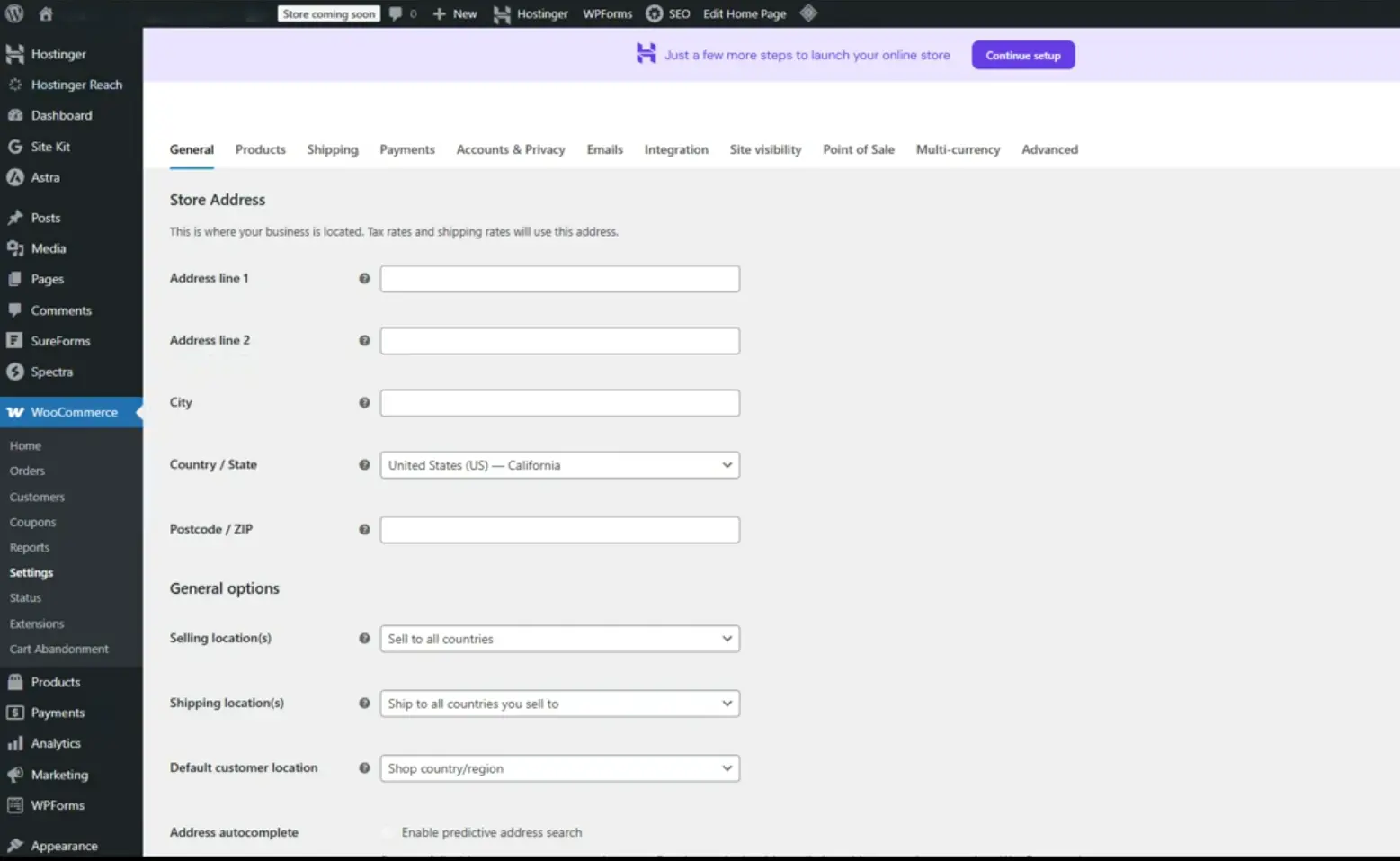
02. The Command Center Analysis: Inside the WordPress Engine
To prove how Hostinger bridges the gap between raw server infrastructure and everyday business management, look at our lead researcher capture of their live administrative environment below.
03. The Thermodynamics of Server Speed: Why LiteSpeed Matters
In our Master Platform Blueprint, we established that digital friction destroys conversion rates. In server engineering, the single most critical metric is Time to First Byte (TTFB), which is the split-second interval it takes for a web server to acknowledge a customer's click and send back the first byte of product data.
Most traditional web hosts run on an older server software called Apache. Apache handles visitors like a tired bank teller serving one person in line at a time. When fifty customers click on your store during a promotion, the Apache teller gets overwhelmed, lines build up, and your store freezes. Hostinger runs on LiteSpeed Web Server technology. LiteSpeed handles web traffic through an advanced, event-driven architecture that serves thousands of visitors simultaneously without breaking a sweat.
Furthermore, Hostinger includes built-in LiteSpeed Object Caching (LSCache). Caching means taking pre-calculated digital snapshots of your store pages and storing them in superfast memory. When a customer lands on your shop, the server does not have to assemble the page from scratch by querying the database. It hands over the pre-built snapshot in milliseconds. For dynamic WooCommerce stores, where shopping carts and live inventory must remain accurate, Hostinger's caching rules are pre-configured out of the box so that customer carts are never cached while product pages load at lightning speeds.
The Lab Glossary: Speed and Performance Engineering
Time to First Byte (TTFB): The precise time it takes for a server to respond after a customer clicks your website link.
LiteSpeed Web Server: High-performance server software engineered to handle massive amounts of web traffic using very little computer memory.
Caching: Storing temporary copies of your website files in fast memory so visitors do not have to wait for the database to reload on every click.
Object Caching: A specialized speed tool that remembers complex database queries like product categories and customer reviews for instant delivery.
NVMe Storage: Ultra-fast solid-state hard drives that read and write data up to seven times faster than traditional computer drives.
CDN (Content Delivery Network): A worldwide network of connected servers that stores your store images close to where your customers physically live.
04. The Founder Journey: How The Goodness Project Scaled Sustainable Commerce
To understand what sovereign hosting looks like in practice, consider the journey of The Goodness Project, an ethical e-commerce company specializing in curated vegan gift boxes, natural wellness hampers, and bespoke corporate bundles in the United Kingdom.
Their business model required deep customization. They did not just sell standard single products. They offered a bespoke hamper builder where corporate clients could hand-select specific dietary snacks, organic wines, and personalized greeting cards. Closed software platforms felt like a trap: they charged expensive monthly app subscriptions for every custom product field and imposed strict checkout rules that made corporate invoicing impossible. The founders committed to WooCommerce to retain complete sovereign control over their database and customer relationships.
However, like many growing brands, their early challenge was server stability. During peak seasonal holidays like Christmas and Valentine's Day, their marketing campaigns sent sudden surges of thousands of concurrent shoppers to their hamper pages. On cheap shared hosting, their checkout crawled under the load, causing abandoned carts. By deploying their WooCommerce engine on optimized cloud infrastructure with LiteSpeed caching and dedicated memory resources, their storefront maintained lightning-fast page loading during the highest-traffic weeks of the year. Today, The Goodness Project operates as an established multi-million-pound ethical enterprise, proving that open-source WooCommerce on high-performance cloud hosting provides all the horsepower of an enterprise platform without the corporate rental fees.
05. The Financial Audit: Hostinger 2026 Tiers and Costs
As Lead Researchers, we must look at the balance sheet. Hostinger is widely recognized as the pricing disruptor of the web hosting industry. Here is the realistic cost breakdown for merchants deploying WooCommerce in 2026.
The 2026 Hostinger WooCommerce Price Stack (Duration Audit)
- Premium Plan (Entry-Level Foundation): If you choose the maximum 48-month commitment, you pay roughly $2.99 per month billed as approximately $143.52 upfront. If you prefer a standard 12-month commitment, the introductory rate is roughly $3.49 per month billed as approximately $41.88 upfront for your first year. Upon contract renewal, the plan renews at roughly $7.99 per month. Includes support for up to one hundred websites, standard server resources, a free domain name for your first year, and unlimited free SSL security certificates.
- Business Plan (The WooCommerce Sweet Spot): If you select the 48-month commitment, the rate is roughly $3.99 per month billed as approximately $191.52 upfront. If you choose the 12-month commitment, the rate is roughly $4.49 per month billed as approximately $53.88 upfront for your entire first year. Upon renewal, the plan renews at roughly $8.99 per month. This plan increases performance fivefold, unlocks NVMe solid-state storage, automated daily backups, and one-click WordPress staging environments.
- Cloud Startup Plan (High-Volume Dedicated Power): Billed at roughly $9.99 per month on an extended commitment or roughly $12.99 per month on an annual contract. Renews at roughly $19.99 per month. Your store is isolated on dedicated virtual cloud resources with twenty times more speed capacity, a dedicated IP address, and priority customer support routing. Engineered for active flash sales and thousands of catalog items.
Tycoon Transparency: A founder choosing the 12-month Business Plan pays roughly $53.88 upfront today for an entire year of managed cloud hosting, a free domain, and daily backups. Compare that single payment to Shopify's $468 baseline per year before adding paid apps.
06. The Four Critical Pillars of Hostinger Commerce
Our lab investigations evaluated Hostinger across the four non-negotiable operational requirements of modern online retail:
1. One-Click Staging Environments: A staging environment is an identical clone of your website that lives on a private web address. When WooCommerce releases a major software update, you should never test it on your live store where paying customers are browsing. In hPanel, you click one button to generate a staging clone, test your updates safely, and push the verified changes live with zero downtime.
2. Automated Daily Backups: The nightmare of every sovereign merchant is waking up to discover that a database table was corrupted. Hostinger Business and Cloud plans take automated daily snapshots of your store files and customer databases. If disaster strikes, you restore your entire operation to the exact state it was in yesterday with a single click.
3. Security and Free Lifetime SSL: An SSL certificate encrypts customer passwords and credit card data in transit. Without it, web browsers flag your store as dangerous, scaring away visitors. Hostinger installs automated, self-renewing SSL certificates on all domains for free, satisfying PCI-DSS compliance requirements out of the box.
4. Human Support That Speaks English: Hostinger provides 24/7 live chat support in over ten languages directly inside hPanel. When you run into a server question at midnight, you do not submit a bureaucratic email ticket and wait three business days. You connect with a trained server specialist within minutes.
Hostinger has successfully dismantled the technological barrier to entry for self-hosted commerce. By pairing the visual simplicity of hPanel with the enterprise muscle of LiteSpeed Web Servers, they have made sovereign WooCommerce accessible to non-technical entrepreneurs at a fraction of the cost of closed platforms. It is the most financially responsible, technically competent starting foundation for any founder who refuses to rent their digital soil.
Lab Rating: 9.8/10, The Best Value Cloud Foundation
Primary Recommendation: Skip the basic tier and select the Business plan. The inclusion of automated daily backups, NVMe storage drives, and one-click staging environments provides the exact safety net a growing merchant needs to scale with complete peace of mind.